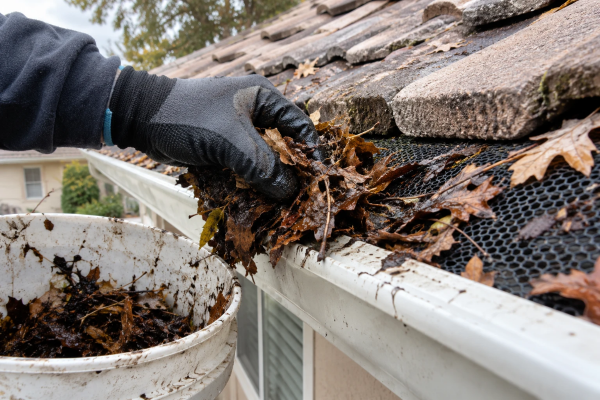

Quick answer: On a single story home with a shingle roof, firm level ground, and no power lines nearby, cleaning your own gutters is a fair weekend job. Call a pro for a two story home, a tile roof, lines near the roofline, gutters packed with wet oak debris, or a clogged underground drain. Not sure yours need it yet?
Quick Verdict: Should You Clean Your Own Gutters?
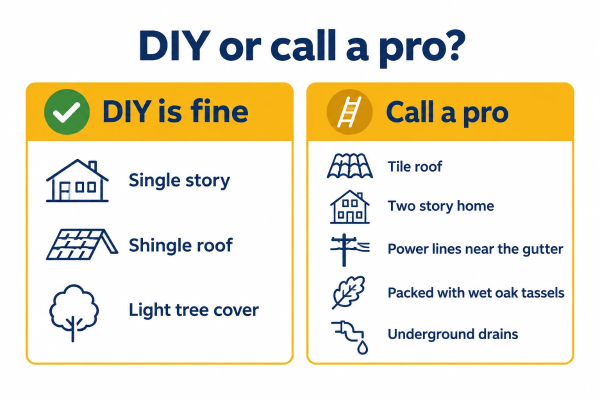
Your home | DIY or pro? | Why |
|---|---|---|
Single story, shingle roof, light tree cover | DIY is fine | Short ladder, easy reach |
Single story with a tile roof | Pro | Tile can crack under a ladder or foot |
Two story home | Pro | Taller ladder, longer fall |
Power lines near the gutter | Pro | Risk of electric shock |
Gutters packed with wet oak tassels | Pro | Heavy, slow work on the ladder |
Downspout drains underground | Pro | Needs a drain snake and flow test |
This DIY vs professional gutter cleaning table covers most Roseville homes. Sun City’s single story homes often fit the DIY row, while the two story streets of Westpark and Fiddyment Farm usually do not.
What DIY Gutter Cleaning Really Takes
Most homeowners already own a ladder, gloves, a bucket, and a hose. Add a plastic gutter scoop and you have the basic kit. What you actually spend is an afternoon of your time and the chance of a fall. Expect a few hours on a typical single story home, more if the gutters have not been cleaned in a year or two.
How to Clean Gutters Yourself, Step by Step
If your home fits the DIY row above, here is how to clean your own gutters the way a careful crew does.
Set Up Your Ladder the Safe Way
Check for power lines first.
Scan the wires overhead each time you shift the ladder to a new spot. Roseville Electric says never to approach or touch downed lines and to call 911 if you see sparking wires (Roseville Electric).
Set the angle.
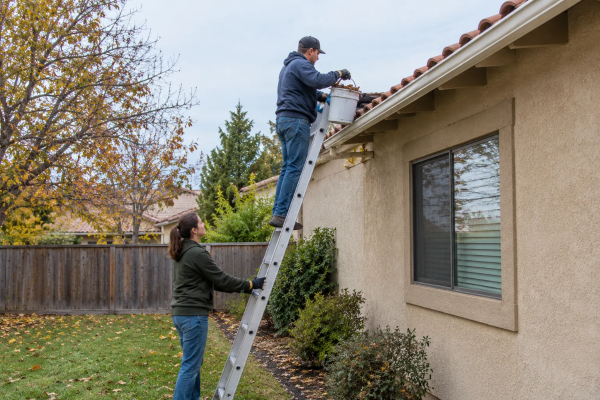
OSHA says the distance from the wall to the ladder’s feet should be about one quarter of the ladder’s working length (OSHA). For every 4 feet up, set the base about 1 foot out.
Extend above the edge.
OSHA calls for side rails at least 3 feet above the landing when you climb onto a surface.
Grip a rung or rail with at least one hand
on the way up and down, and treat the top step of a stepladder as off limits.
Climb down and reset the ladder every few feet
rather than stretching sideways. If your belt buckle passes the side rails, you are reaching too far.
Scoop Wet Debris, Blow Out Dry Debris
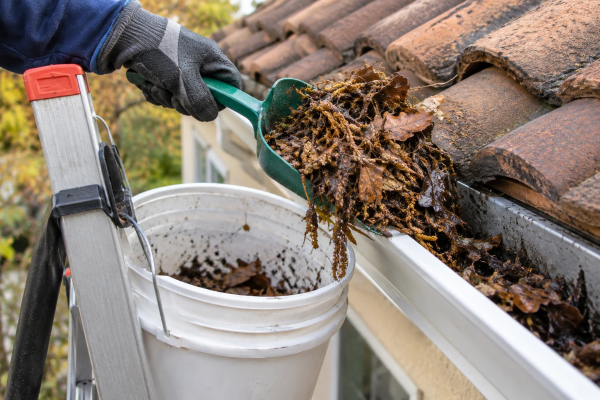
Wet leaves and oak tassels pack into a heavy mud. Lift that sludge out with a plastic scoop, a handful at a time, into a bucket hooked to a rung beside you. Dry debris, after about a week without rain, can be blown out with a blower attachment. Blowing wet debris only sprays mud across the walls and windows.
Flush and Test the Downspouts
Start the water at the end farthest from the downspout and follow it as it travels down the run. Then drop a penny into the top of the downspout and listen for it to come out the bottom. Water that pools or climbs back up the opening points to a plug in the elbow. Use a hose with a shutoff nozzle. Roseville’s water rules ban free flowing hoses and require an automatic shutoff device on any hose in use (Roseville Municipal Code). For stubborn clogs, see the downspout clean out page.
Bag It or Use Your Green Waste Cart
Leaves and small twigs can go in your Roseville green waste cart, which is picked up every other week (City of Roseville). Spread a tarp under the ladder first so the mess stays off your beds and lawn.
What Is the Best Tool to Clean Gutters?
Pick your tool by the kind of mess sitting in the gutter. Here is what works on Roseville debris.
Tool | Best for | How it handles wet oak tassels |
|---|---|---|
Plastic gutter scoop | Packed, wet debris | Works well |
Thick work gloves | Grabbing clumps, sharp seams | Works well |
Hose with shutoff nozzle | Final rinse, downspout test | Rinses after scooping |
Blower attachment | Dry leaves in summer | Poor, sprays mud |
Telescoping wand from the ground | Light, dry debris on one story | Poor on heavy mats |
Wet and dry shop vacuum | Dry debris, small grit | Clogs on wet clumps |
For a deeper look at each method, read the guide to hand scooping vs vacuums vs pressure washing.
How Do Professionals Clean Gutters?
A good provider follows the same routine on every Roseville roofline, from Sun City ranch homes to two story houses near Mahany Park. The crew checks for lines, sets ladders with stabilizers so nothing rests on the gutter, and works from the ladder on tile roofs instead of walking on them. Wet debris is scooped by hand, and dry debris is blown out only when it is safe. Then every downspout is flushed and tested, the hangers that sit about every two feet are checked, and you get before and after photos. That full process is what professional gutter cleaning should include. Ask any provider whether it covers each step. If you are comparing a pro with a handyman, see the pro vs handyman guide.
When to Skip DIY in Roseville
Some jobs are not worth the risk. The Consumer Product Safety Commission estimates about 227,000 emergency room visits for ladder and stool injuries in 2020 (CPSC). Call a pro when:
DIY Gutter Cleaning Tips
Clean in a dry week in late October or November, after most oak leaves fall.
Start at the corner farthest from the downspout and work toward it.
Wear gloves. Gutter seams and screw tips are sharp.
Never use a pressure washer on a tile roof or old gutter seams.
Have a second person hold the ladder base.
Take photos of any sagging hanger or leaky seam so a licensed pro can look at the fix.
If you have guards, lift a section before you assume the gutter is clean. The gutter guard cleaning page explains why.
DIY vs Pro Gutter Cleaning: FAQs
More questions? Want more quick answers? Visit our gutter questions page.
Rather Stay Off the Ladder?
If your home is two stories, has a tile roof, or you would simply rather not climb, hire a local provider. Call (279) 278-7800. You can also read more about gutter cleaning in Roseville. Comparing companies first? Use the checklist of the best gutter cleaning companies in Roseville.