
A warehouse roof can cover an acre or more, yet it drains through only a few outlets.
When one of those outlets clogs, water either comes indoors or sits on the roof.
This industrial gutter cleaning guide covers what to clean, how often, and how to stay safe.
Roseville’s Industrial Areas
Roseville has set aside a lot of land for this kind of building. The city’s North Industrial Planning Area covers 2,046 acres west of Washington Boulevard and is planned to hold about 31,346 jobs (City of Roseville). City figures also show industrial space in Roseville at 95.8 percent occupied (City of Roseville). With nearly every bay leased, a drip from above lands on pallets, forklifts, or a worker’s desk rather than an empty slab.
Typical sites include concrete tilt up warehouses off Washington Boulevard, flex buildings along Industrial Avenue, and service yards with metal shop roofs.
How Big Roofs Drain and Where They Clog
Large flat roofs do not shed water like a house. Water has to travel across a wide, nearly level surface to reach a handful of exits. The engineering firm Rimkus lists clogged drains, scuppers, and strainers as common drainage problems on commercial roofs (Rimkus).
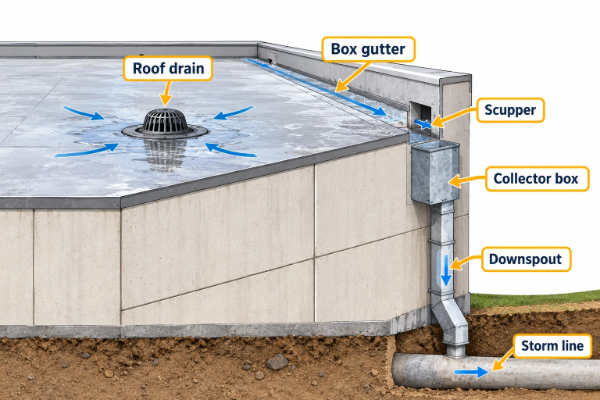
Outlet type | Spot on the building | What chokes it | Result once it backs up |
|---|---|---|---|
Box gutter | Built into the roof, often along a wall or between two roof sections | Leaves and grit settle in long, level runs | Water rises over the lining and can drip inside |
Scupper and collector box | Opening in the parapet wall, with a box and downspout outside | Trash and leaves jam the opening or the box | Water backs up on the roof |
Roof drain and strainer | Round drain set into the roof deck | Debris mats over the dome strainer | Ponding around the drain |
Long downspouts and buried lines | Down the wall and into site storm lines | Packed elbows and silt in the line | Overflow at the collector box |
Built in gutters deserve extra care. Because they sit inside the roof line, an overflow does not spill to the parking lot. It can soak insulation and drip onto racks below. The cleanup inside is often a far bigger job than the cleaning outside.
Water Weight on a Flat Roof
Standing water is heavy. Rimkus notes that each inch of depth adds about 5.2 pounds per square foot, based on the ASCE 7 load standard. Here is what that means at warehouse scale:
Roof area | 1 inch of ponding | 2 inches of ponding |
|---|---|---|
10,000 sq ft | About 52,000 lb | About 104,000 lb |
50,000 sq ft | About 260,000 lb | About 520,000 lb |
100,000 sq ft | About 520,000 lb | About 1,040,000 lb |
Real ponding is uneven, so these are rough totals, but they show why drains matter. That same article describes a snowball effect engineers call ponding instability: the deck bows under a puddle, the bowl gets deeper, more rain flows in, and the bow grows. To give water a second way out, code requires secondary outlets placed 2 inches above the lowest point on the roof. If those backups run during ordinary storms, the main drains are likely plugged.
Short bursts are what test a roof. NOAA data for downtown Roseville shows a 10 year, five minute burst at about 2.35 inches per hour. The guide on why clean gutters overflow explains those numbers, and the atmospheric rivers guide covers the long winter storms.
What Builds Up on Industrial Roofs

Safety on Large Roofs
Warehouse roofs look flat and easy, but they hide some of the worst fall hazards in the trades.
Edges. Federal OSHA rules for low slope roofs require guardrails, safety nets, travel restraint, or personal fall arrest for work within 6 feet of the edge (OSHA 1910.28). Gutter, scupper, and collector box work happens right at that edge. California runs its own program through Cal/OSHA, with rules that must protect workers at least as well (Cal/OSHA).
Skylights. A NIOSH Alert on falls through skylights and roof openings found that 14 of 64 reported fatal falls in a seven state survey involved skylights. It urges railings or screens on every skylight and training so workers never sit or step on one (NIOSH Alert). Many tilt up warehouses have rows of them.
Access. Crews should use the roof hatch or a lift, not a ladder against a tall concrete wall.
Stormwater Rules for Industrial Sites
Roseville’s stormwater page for businesses states that “only stormwater and specifically authorized discharges are allowed into the storm drain system,” and it lists wash water from power washing parking lots as a banned discharge (City of Roseville). The city’s stormwater code counts yard waste and rubbish as pollutants (Roseville Municipal Code 14.20).

On a big site, that means debris from the roof is bagged and hauled, not swept off the edge into the truck court. Questions about a specific site go to the city’s stormwater line at (916) 774 5780.
How Often to Clean
Rimkus cites the National Roofing Contractors Association’s advice for professional roof inspections twice a year, plus extra checks after severe weather. For drains and gutters, timing should follow Roseville’s trees and rain.
Site | Suggested cleanings | When |
|---|---|---|
Few trees, flat roof, scuppers | 2 a year | Late October and April |
Street trees or oaks nearby | 3 a year | October, January, May |
Built in gutters or heavy bird activity | 3 to 4 a year | Fall, midwinter, spring, plus after big storms |
Any site | After each major storm | Within a few days |
The gutter maintenance calendar shows the local timing, and the guide to commercial maintenance plans explains how set schedules work.
Scheduling Around Docks and Shifts
Warehouse gutter cleaning has to fit around trucks and people. Ask the provider about:

Repairs Found During Cleaning
Repairs found during cleaning are usually a separate job. Each one gets its own written scope. In California, any repair worth $1,000 or more in labor and materials must be done by a licensed contractor (CSLB).
Industrial Gutter FAQs
Find a Provider for Your Site
For industrial gutter cleaning from Washington Boulevard to the business parks off Foothills Boulevard, a good provider starts with a site walk. Then it writes a scope. Read more about commercial gutter cleaning in Roseville. For homes, visit the main page on Roseville gutter services. Call (279) 278-7800.
Related reading: why commercial buildings can’t skip gutter care and gutter drainage problems.