
When roof water lands next to the house, the soil and the slab pay for it.
Most trouble traces back to a clog, a short downspout, a flat gutter, or ground tilted the wrong way.
Here is how to spot each one, and how to fix it starting with the simplest step.
How Do Gutter Drains Work?
Rain runs off the roof into the gutter. A good trough runs slightly downhill so every drop heads for the hole at one end. The water drops down the downspout and leaves at the bottom. It lands on a splash block or flows into a buried pipe that carries it across the yard. Every link has to work. When one fails, the water stops moving away and soaks in next to the house. That is where most gutter drainage issues begin.
Common Gutter Drainage Problems
Clogged Gutters and Downspouts
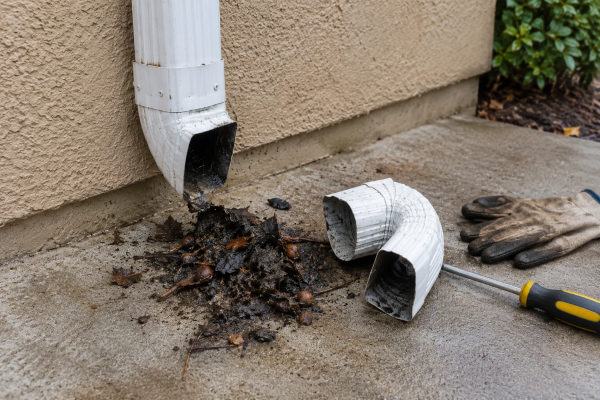
A plug anywhere in the system sends water over the gutter lip, usually right where it does the most harm. Our guide to blocked gutters shows how to find a clog in the trough, and our guide on how to unclog a downspout covers the pipe.
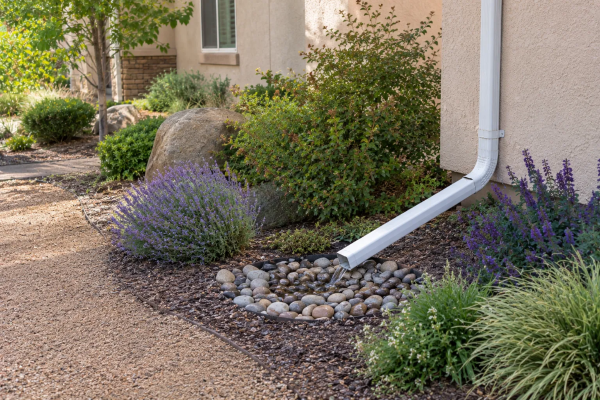
Downspouts That Dump Next to the Wall
A downspout that ends at the base of the stucco dumps the rain from a whole side of the roof into one small patch of soil. The U.S. Department of Energy’s Building America Solution Center says downspouts should end at least 5 feet from the foundation, and lines tied to an underground system should reach at least 10 feet out (DOE Building America Solution Center).
Gutters With Too Little Slope
A bent bracket, or a trough that was installed dead flat, leaves a shallow pool halfway along the run that never makes it to the drop. Look for a grit line after the rain.
Ground That Slopes Toward the House
The California Residential Code says the ground next to a home “shall fall not fewer than 6 inches” within the first 10 feet, and that hard surfaces within 10 feet should slope at least 2 percent away from the building (CRC Section R401.3, quoted by GoCodeBook). New mulch, raised beds, or a sinking patio can tip that slope back toward the house over time.
Underground Drain Lines That Back Up
A buried line that fills with leaves or grit stops carrying water away. The downspout then overflows at the bottom joint, or water pushes up out of the lawn near the house.
Too Few Downspouts for the Roof
The DOE guide places downspouts every 20 to 50 feet along a gutter. Picture a long back run on a big two story home with one downspout at the far corner. In a heavy storm, it can overflow even when it is clean.
How Poor Drainage Damages a Foundation
Clay Soil That Swells and Shrinks
Some Roseville ground is stiff clay. A Placer County environmental report for a site on Old Auburn Road in Roseville described the native soil there as “moderately expansive,” with lab tests showing a medium expansion potential (Placer County EIR, Geology and Soils). Soil like that grows when it soaks up water and pulls back as it dries. Roseville swings from bone dry in August to waterlogged in February, so the soil goes through that stretch and squeeze every single year. A downspout that dumps in one spot makes one side of the slab move more than the rest.
Wet Crawl Spaces and Mold
Older homes in Cherry Glen, Diamond Oaks, and the blocks near Vernon Street often sit over crawl spaces. The EPA says “the key to mold control is moisture control,” and it tells homeowners to keep gutters clean and slope the ground away from the foundation (EPA).
Eroded Beds and Undermined Walkways
Water pouring off one corner cuts a trench in the mulch. It washes soil out from under a walkway edge. Give it a few winters and you may see a hollow opening up beneath the concrete lip of the foundation.
Warning Signs to Watch For
These signs have many possible causes. If you see them, have a licensed foundation professional look before anyone guesses.
How to Fix Gutter Drainage Problems
Start at the top. Most homes stop by the third row.

Fix | When it helps | Who does it |
|---|---|---|
Clean gutters and downspouts | Any overflow | DIY or gutter crew |
Add an extension or splash block | Outlet ends at the wall | DIY |
Reset gutter slope or hangers | Standing water in the run | Gutter crew |
Rebuild the slope beside the walls | Dirt runs back toward the house | Excavation or yard grading pro |
Flush or repair a buried line | Line backs up | Gutter crew or contractor |
Add a downspout | Long run, one outlet | Contractor |
Send water to a planted bed | Lot has room | DIY or yard crew |
The EPA suggests sending downspout water to a planted area. It also says to check local rules first, so the water does not cause harm somewhere else (EPA). In California, any repair worth $1,000 or more in labor and materials must be done by a licensed contractor (CSLB).
Underground Gutter Drainage Problems
Buried lines hide their trouble until it rains. Watch for:
Leaves and grit, roots in old joints, crushed pipe under a driveway, and sections laid too flat are the usual causes. The DOE guide calls for buried pipe to fall at least 5/8 inch per foot. A provider that offers gutter drain cleaning can push water and a cable through the buried pipe. Ask for pictures of what they find so you can decide on any digging.
Roseville Drainage: Creeks, Storms and Your Lot
Roseville knows high water. The city counts 209 structures flooded in 1986 and 358 in 1995, and it became the first community in the nation to earn FEMA’s Community Rating System Class 1 (City of Roseville Flood Facts). Those floods came from Dry Creek, Cirby Creek, and Linda Creek. Your gutters cannot change a creek, but they decide where every drop from your own roof lands.
NOAA says about 30 to 50 percent of yearly rain in the West Coast states falls in just a few atmospheric river storms (NOAA). That means a short downspout gets tested hard a few times each winter, not gently all year. Our year round gutter plan shows when to clear the system before those storms, and our Roseville weather guide covers the storm season in more depth.
When to Call a Pro
If water is pouring against the house during a storm, read our emergency gutter cleaning guide first.
Gutter Drainage FAQs
Get a Gutter and Downspout Check
A good provider will clear every gutter and downspout, check each outlet, and send photos showing where your water lands, from Sun City to Fiddyment Farm. See the house gutter cleaning in Roseville page, or start with the main page on gutter cleaning around Roseville.
Call (279) 278-7800.