

A clogged gutter on a business looks like a small thing from the parking lot.
Then the water reaches a walkway, a ceiling, or a tenant’s stock.
At that point it turns into a safety, legal, and budget problem.
Here are the seven real risks of letting commercial gutter maintenance slide, with the numbers behind each one.
Risk 1: Slips and Falls at Entrances
Overflow rarely lands somewhere harmless. On a shopping strip, it drips right in front of the doors. On a medical office near Eureka Road, it can puddle at the patient drop off. Wet concrete, algae, and stained pavers all raise the odds of a fall.
Falls are already one of the biggest injury types at work. The Bureau of Labor Statistics counts 721,720 private industry cases of falls, slips, and trips in 2023 to 2024 that led to days away from work or restricted duty (BLS). Every one of those started somewhere, and wet walkways are a common place.
The law also expects owners to keep up. California’s standard jury instruction on premises liability says a person who owns, leases, or controls property must use reasonable care to find unsafe conditions and to repair, replace, or warn about anything that could harm others (CACI No. 1001). A gutter that spills on the same entrance every storm is the kind of condition a jury may ask about. This guide is not legal advice, so run any real dispute past your own attorney.
Risk 2: Weight and Leaks on Flat Roofs
Many Roseville retail centers and business parks have flat roofs. Their drains and scuppers clog with leaves, trash, and roof grit. The engineering firm Rimkus notes that each inch of standing water adds about 5.2 pounds per square foot, and it links some historic roof collapses to blocked outlets that let water pool past what the deck could hold (Rimkus).
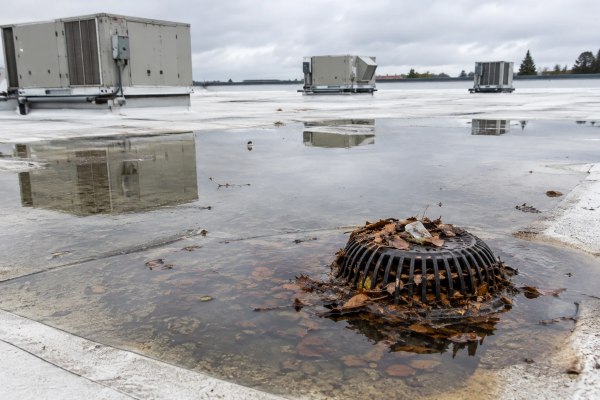
Even short of a collapse, ponding wears out roof membranes and finds every weak seam. Managing a tilt up warehouse or a big box roof? Our industrial gutter cleaning walkthrough digs into drains, scuppers, and skylight safety.
Risk 3: Water Inside the Building and Mold
Water that misses the gutter often ends up indoors. The EPA’s mold guide for schools and commercial buildings lists gutters that send water into or under a building as a moisture source, and it says delayed or poor maintenance is tied to moisture problems in large buildings (EPA). The EPA puts the main idea simply: “the key to mold control is moisture control” (EPA).
For a business, that means stained ceiling tiles, wet carpet, ruined boxes in the back room, and days when a suite cannot be used. Tenants notice, and they remember at lease renewal.
Risk 4: Foundations, Paving and Planter Beds
Overflow lands at the base of the wall and soaks the soil next to the slab. A Placer County environmental report for a Roseville site describes the local soil as moderately expansive, meaning it swells when wet and shrinks when dry (Placer County). Season after season of that wet and dry cycle can crack concrete aprons, heave the walk out front, and tip curb sections out of line.
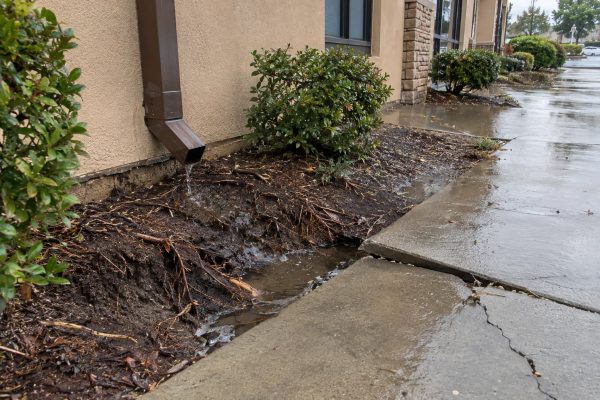
The U.S. Department of Energy says downspouts should end at least 5 feet from the foundation (DOE Building America Solution Center). Our guide to gutter drainage problems explains what that water does below ground.
Risk 5: Stormwater Violations
Picture a crew rinsing a parking lot full of soggy oak leaves after a spill: every bit of that slurry rolls toward the nearest grate in the asphalt. Roseville allows “only stormwater and specifically authorized discharges” into its storm drains (City of Roseville). The city’s stormwater code lists yard waste and rubbish as pollutants (Roseville Municipal Code 14.20). Regular cleaning with bagged debris keeps leaves on the roof from becoming a problem in the parking lot. Questions go to the city’s stormwater line at (916) 774 5780.
Risk 6: Insurance and Records
Whether water damage is covered depends on the policy. The California Department of Insurance notes that policies can cover damage from wind driven rain in a storm, while they typically exclude flood (CDI). Read your policy for maintenance exclusions, and ask your agent how routine upkeep affects a claim.
Dated photo reports from each gutter visit give you a clean record of care. That file is useful for owners, boards, buyers, and any adjuster who asks.
Risk 7: Fire Season
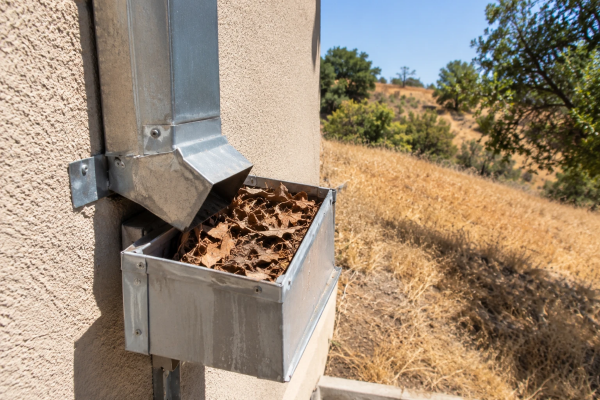
By August, leaves left in gutters and scuppers are bone dry. CAL FIRE tells property owners to “keep gutters free from plant debris to prevent ember ignition” and warns that embers can travel up to a mile (Ready for Wildfire). Roseville received updated Fire Hazard Severity Zone maps on February 10, 2025, and any address can be checked on the city’s map (City of Roseville). Business sites that back onto open space along Dry Creek or the west side preserves should plan a summer clear out.
What Skipping Really Costs
Some of the biggest losses are the hardest to count: a slip claim, lost rent, or damaged stock. In California, any repair worth $1,000 or more in labor and materials must be done by a licensed contractor (CSLB).
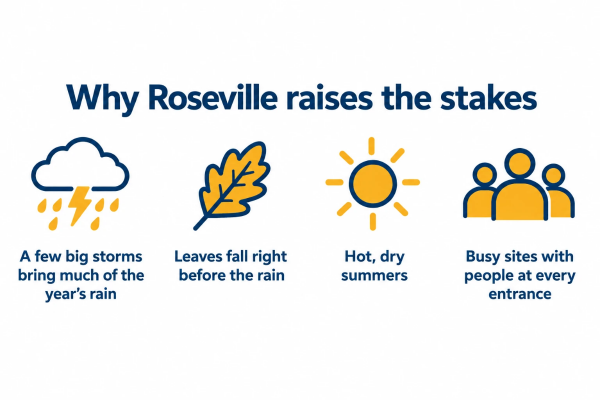
Roseville Factors That Raise the Stakes
If your gutters spill even after cleaning, read why clean gutters overflow.
A Simple Plan That Prevents Most of It
Set two to four visits a year
, timed to late fall, winter storms, and the spring oak bloom.
Add storm checks
after major rain.
Ask for photo reports
and keep them in one vendor file.
Quote repairs separately
so small fixes do not wait.
Keep one vendor
who knows your roofs, gates, and contacts.
Our guide to commercial contracts and maintenance plans shows how to set this up, and the rain gutter cleaning in Roseville page covers storm season timing.
Maintenance FAQs
Get a Risk Check for Your Property
From office parks off Foothills Boulevard to retail centers near the Galleria, a good provider will walk the roofline, photograph problem spots, and give you a written plan. Learn more on the commercial gutter cleaning in Roseville page or the main page on Roseville gutter cleaning.
Call (279) 278-7800.